
2026-09-08 · Wallion
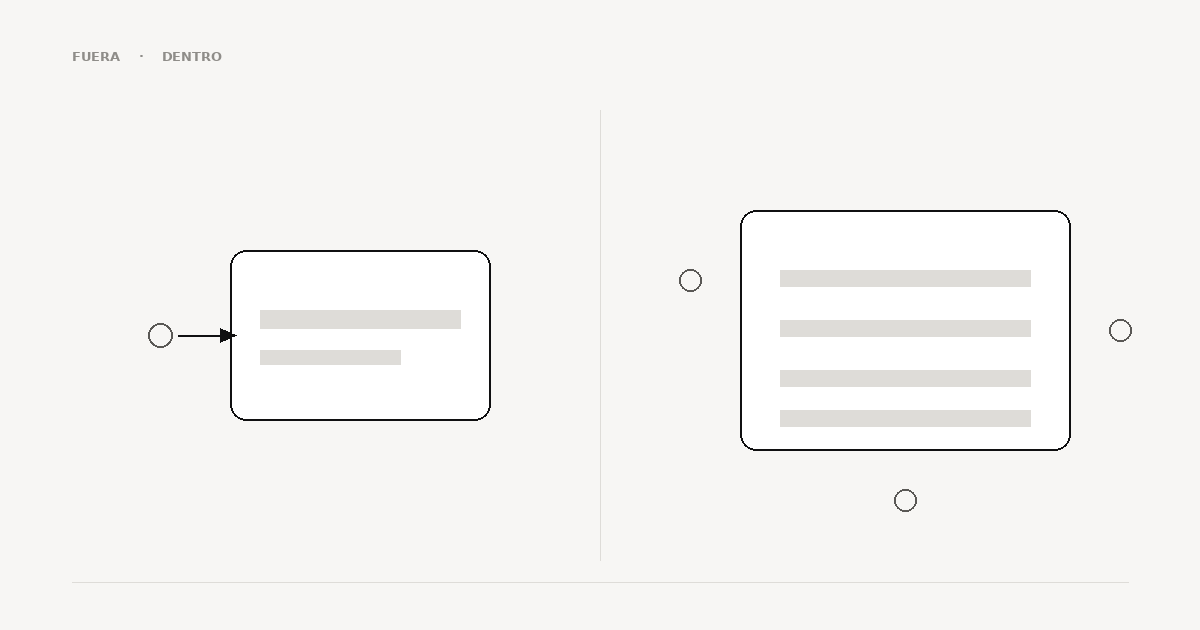
An MVP and an internal tool are similar in size. Both can be completed in weeks. Both involve cutting costs. They're not the same work—not the same price range, not the same "done" criteria.
The MVP is used by someone from outside. The tool is used by the team. If you mix the two phrases into a single scope, you construct both incorrectly: the outsider doesn't finish, the month doesn't close, and the budget compares to the wrong figure.
This page separates. It does not define: What is a studio MVP?. It doesn't decide if the MVP makes sense: When does an MVP make sense?. The commission, depending on the side, lives in MVP for startups or in internal tools, both under custom software. Wallion does not open a root URL /mvp.
The short answer
| MVP | Internal tool | |
|---|---|---|
| User | Stranger (customer, shop, workshop, buyer) | Internal role (admin, ops, closure) |
| Cutout | It hurts outward. | It hurts on the inside. |
| Sign | He returned / paid / ordered the next one | The data is available on the 28th; the manual step disappears |
| Charge | Fixed price in writing (another figure) | Public band €6,900–14,900 = a flow |
| Landing | /software/mvp | /software/herramientas-internas |
If both rows fit within the same scope paragraph, they are two projects. Write them down separately. Budget them separately.
He's an MVP
There's a stranger. A customer, a local business, a workshop that doesn't charge you. They're going to do something the week it's due. You check if they come back, pay, or order the next piece without you selling it to them.
The cutout hurts. Screens that the stranger doesn't need for that thing are left out. The dream internal panel doesn't fit. The full definition is in What is a studio MVP?; the decision to commission it, in when it makes sense.
The measure of success is his, not the meeting's. Did he pay? Did he come back? Did he order the next round without being pressured? If you're measuring "does the month close?", you're not measuring an MVP.
It's an internal tool
The user works here, or invoices here, or closes the month here. There are no strangers. There's a workflow that currently exists on a sheet of paper, an email, or three tools that don't communicate with each other—and when it fails, it halts the closing process.
The cut hurts internally. He's out "all month." He comes in. a flowThe one that stops when it fails. Replacing the sheet that blocks the 28th is the pattern, not "digitizing the company".
The success criterion is operational. On the 28th, the issue is ready. The person who used to enter it manually no longer does. No one "buys again." The month either ends or it doesn't.
How not to mix them
Don't ask for "an MVP for the team.". That's a half-baked tool with a product name. The team isn't a market. If only people in-house use it, it's a tool—even if it sounds like a startup.
Don't ask for "a tool that we will also sell.". On day one, the owner is an insider. The outsider arrives later, if they arrive at all. That "later" is another job, another line of inquiry, another price. Don't hide it in the same budget.
Don't measure a tool by "Did the partners like it?". Don't judge an MVP by asking "Is the month over?". Everyone has their own question. If you can't write it down beforehand, don't even start.
Don't compare the €6,900–€14,900 range with an MVP. That band is an internal tool / a flow After the diagnosis, apps, MVPs, and staffing will be... price fixed in writing — same model, different price. Mixing the two in the same negotiation is the most expensive mistake on this page.
Don't invent a /mvp root. The module hangs from the hub: /software/mvp y /software/herramientas-internas.
One line each
MVP: “A stranger does an action and I see a sign.”
Tool: “The [role] stops doing [this step] and the [data] remains in [this place].”
Tabletop examples (without fictitious clients): “A workshop sends the quote and I see if they accept it in seven days.” vs “The admin person stops copying the closing to the sheet and the number remains in the system on the 28th.”
If both lines fit in the same paragraph, they're two separate projects. Write them out separately. Budget them separately. If you're unsure which one to write, don't sign "MVP" or "tool": you're just creating confusion.
Separation table (quick decisions)
| Ask | If you answer… | So it is… |
|---|---|---|
| Who uses it the week it comes out? | A buyer / local / workshop from out of town | MVP |
| Who uses it the week it comes out? | Only people from home | Tool |
| What are your measurements? | He returned / paid / ordered the next one | MVP |
| What are your measurements? | The month ends / the manual step disappears | Tool |
| What hurts when you cut? | Screens that the stranger doesn't need | MVP |
| What hurts when you cut? | “All month” vs. a single flow | Tool |
| What figure are you comparing? | Fixed written after diagnosis | MVP (u app / staffing) |
| What figure are you comparing? | €6,900–14,900 | A tool / a flow |
Failure modes
MVP with internal user. You call the monthly sheet a product. The "market" is the Monday meeting. You learn zero about buyers—and you budget incorrectly if you view the toolband as if it were the fixed cost of an external product (or vice versa).
Tool with product pitch. “We build it for ourselves and then sell it.” On day one, there are no strangers. The scope is inflated with sales screens that no one will ever test. Two orders in one: both come out flawed.
Same phrase, two jobs. “MVP + internal panel + month-end closing” in a single reach. The studio doesn't know what “done” means. Neither do you. The fixed rate either expands or inflates.
Wrong band. You ask for an MVP and anchor it at €6,900–€14,900. Or you ask for internal flow and expect a fixed product price. Option D is clear: that range is a tool / a flow; MVP = fixed written.
Staffing with product or tool label. Live backlog, you need hands. Say so. It's neither an MVP nor a "flow" with a fixed price for a single piece.
Compare with Mobility, Glowapp or Nummo. These are not Wallion products from this service. They are not for reference.
Public prices (Option D — without inventing other figures)
Only the figures from the site.
- Diagnosis — €1,900. Written scope, prototype, fixed budget. If you proceed, it's deducted from the construction cost. It helps in making decisions. which of the two of you — and so as not to sign the wrong name.
- Construction — €6,900–€14,900. An internal tool / a flow after the diagnosis. It's not the price of a large app, an MVP, or staffing.
- Building an MVP (or app/staffing): price fixed in writing after the Diagnosis — same model (scope + number + date), another figure, not that band.
- License — from €390/month if Wallion maintains what has been built (hosting, security, regulatory and API changes, small change cap, support during business hours — depending on the offer).
Do not confuse the tool number with the minimum order quantity. Offers: MVP, internal tools. Hub: custom software.
What Wallion does (and when not to buy it)
Wallion is a custom software studio in Barcelona. They build both things — MVPs y internal tools — but on different tables: Diagnosis €1,900 (discountable if you continue); tool / a flow in the range €6,900–€14,900; MVP at a fixed written price; license from €390/month if we maintain what has been built.
Don't buy "an MVP"“ when the user is only the equipment. Don't buy "a tool"“ When the user is a stranger and the signal is market-driven—or request it with the correct name and price. If during the call you say “this is a tool, not an MVP” (or vice versa), it should be mentioned in the first conversation. Geo: /software/barcelona.
Separation list (before ordering)
Check each box. If any are left blank, do not sign your name yet.
- Is there a stranger — or just the team?
- Is the line “does [action] and I see [signal]” or “stops [passing] and the data remains in [place]”?
- External use measurements or month-end closing?
- Does the cut hurt from the outside or the inside?
- Can you write what No Does it fit without including the other side in the same paragraph?
- Are you comparing €6,900–€14,900 (a flow) or a fixed written MVP?
- Are you requesting a diagnostic to choose a name — or an ownerless pilot?
- Have you opened the definition (Studio MVP) and the decision (when it makes sense) before signing?
- Do you need product/tool or hands in a backlog (staffing)?
- Is the "fact" that a stranger ends up — or that the month closes without manual gluing?
Without those answers, the name is marketing. The commission is not.
Questions that buyers do ask
Are they similar in size?
Yes: weeks, cut, a piece. No: user, signal, price band, custom landing page.
Can we start with the tool and "release the product" later?
You can. That afterwards is other commission. Don't put it on the same fixed day as the first.
Does the €6,900–€14,900 price range cover the MVP?
No. That band is an internal tool/flow. The MVP is going to price fixed in writing.
Does the €1,900 diagnostic test help you decide which one it is?
Yes — written scope, prototype, fixed. If you continue, it's discounted. If not, it's not an empty deck.
What does the license include starting from €390/month?
The offer includes: hosting, security, regulatory and API updates, a limit on minor changes, and support during business hours. Major changes: fixed timeframe.
Only Barcelona?
Headquartered in Barcelona. Startups and SMEs in the city, the metropolitan area, and the rest of Spain. Geo: /software/barcelona.
Mobility, Glowapp or Nummo?
No. These are not Wallion products from this service.
Where is each person responsible?
MVP o internal tools, low /software. This page separates; it does not create a root URL /mvp.
What this page is not
It's not the definition (What is a studio MVP?). It is not the decision guide (When does an MVP make sense?It's not the offer (/software/mvp, /software/herramientas-internas; hub /softwareIt doesn't invent tariffs — only Option D. It doesn't treat Mobility, Glowapp, or Nummo as Wallion products.
Thirty minutes
If the roadblock is "is this an MVP or a tool?", say so in the first conversation. Book a 30-minute call.