
2026-09-07 · Wallion
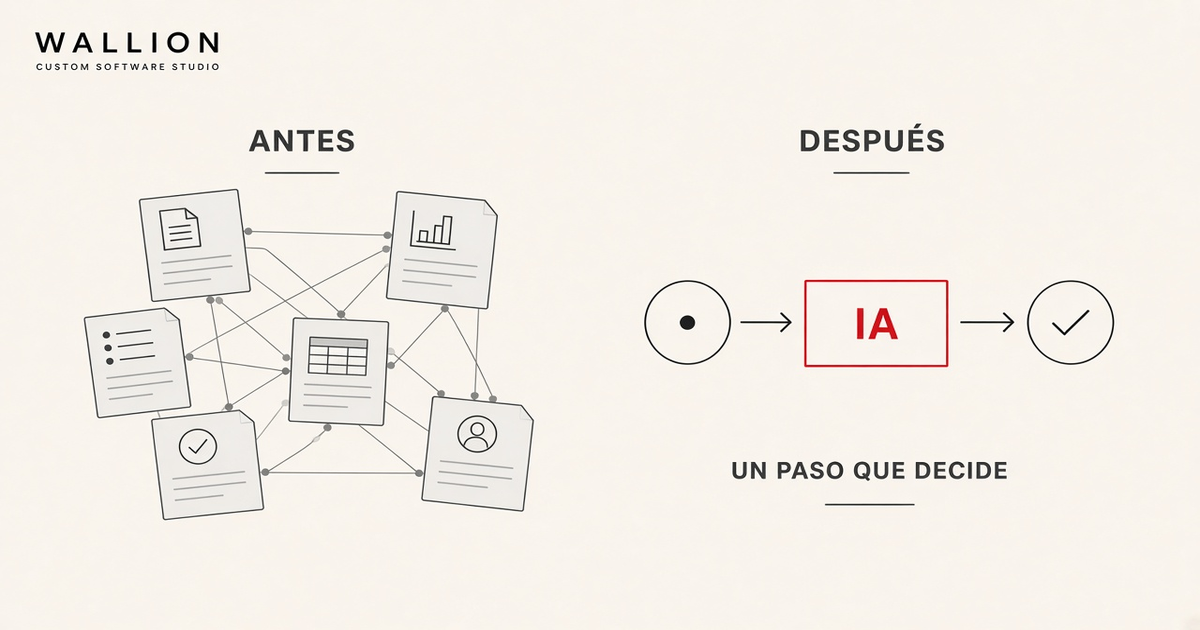
AI automation for SMEs isn't a fad. It's about eliminating a step you already know how to do, a repetitive one, and one that's noticeable when it fails—and, when it adds value, using AI to classify, draft, or route information. inside of that flow.
It's not about "putting intelligence" on top of chaos. If the process isn't documented, AI freezes the error with better prose. If no one looks at the result, it freezes it silently.
This page defines what is and what isn't. The decision guide — when to include it and when to avoid it — is in when to automate a process. The commission offer is in AI-powered automation, within the same custom software.
The short answer
A clear trigger. “When the client accepts…” The data already lives somewhere. Not in a chat. Not in “I remember”.
One action. Create the queue. Notify the billing department. Move the order. One.
A place where the failure is visible. The same day. If the error appears at the end of the month, first make it visible. Then unclick it.
AI only where the data already exists. Classify a document. Generate a report. Route an email to the correct queue. Not "let it think for a month.".
If A and B are already doing the work and only the travel is missing, integrate. If the gap is the work itself, build the flow. The test is the same: one step, one line, one owner. Guide: integrate or build.
What it isn't (and when you don't automate)
It's not about replacing the ERP or the entire tax system in a single order. A bridge is not a system replacement.
It's not a pilot program without an owner that never goes into production. If nobody checks the queue on Monday, you don't have automation: you have a bug that's self-replicating.
It's not a criterion disguised as a cable. If half the cases are exceptions, you need a rule or a person—not a model. The criterion isn't chained together.
Don't automate when the process isn't decided and you're using "AI" to avoid discussing the rule. That doesn't save time. It hides it. When the step changes every week, write the rule first. Then remove the click.
Don't automate just because "you have to have AI." If the click is cheaper than the bridge—less than about ten times a week in your own count—you don't need an industry standard. Count your own.
It's not Mobility, Glowapp, or Nummo. They are not Wallion products of this service.
How it looks at a small business table (Barcelona / Spain)
There's no need for a case study with a logo. The pattern is the table: a founder still signing off on budgets, someone from administration with the spreadsheet that's "almost working," and a partner (consultant, ERP, the A3-type stack next door) quoting the next module when Excel stops working.
In Barcelona, the metropolitan area, and the rest of Spain, that same group of people often asks for the same thing, albeit phrased differently: "that it be done automatically." Sometimes the problem is real—an accepted budget that doesn't generate work, a closed report that no one sends to billing, a new hire that exists in one system but not the other. Sometimes the problem is "digitizing" without a clear plan. Wallion speaks with this type of client frequently: a specific workflow, not "the entire company"; a fixed price; a diagnosis before implementation. No fabricated clients or volumes. The standard is the client, not a case study.
If the trigger resides in Maria's mind and the "according to the customer" criterion changes every Tuesday, it's not an automation project. It's a process conversation. If the data is already in the CRM and only needs to be taken to the warehouse, then it is.
Failure modes (those you have already seen, or will see)
AI on top of the chaos.
You buy an "assistant" without a written trigger. Three weeks later, it writes well... and it's still failing at the same step. Better prose isn't a flow.
Eternal pilot.
There's an n8n, a Zapier, a script. Nobody owns it. Nobody's watching the tail. The bug appears at the end of the month. Visibility first. Then the cable.
Exceptions such as real work.
You've automated the "happy" line. Half the cases come from it. The team is still doing the important work by hand—and now they're also maintaining the bridge. That's not cost-saving. That's a debt to better marketing.
Replacing the ERP “with AI”.
A project that promises to replace the entire tax house or ERP system is not workflow automation. It's a different product. If you need it, it has a different scope and a different price—not this definition.
Cable without “this fits / this doesn’t”.
“Connect everything to everything” is not a goal. It’s a wish. Without a trigger phrase and action, the budget is just a hope with a number.
Compare a flow to a branded product.
Mobility, Glowapp, or Nummo are not this service. Comparing the studio's automation offering with those brands is like mixing apples and oranges.
These mistakes separate a step that stops hurting from a pilot who accumulates.
What Wallion does (and when not to buy it)
Wallion builds automation and AI integrations within the same service of custom software, to fixed price. It starts with a Diagnostic. An internal tool/workflow following the Diagnostic enters the published build pipeline. The license, if we maintain what's built, is monthly.
In short, the model consists of: a trigger, an action, a location where the failure occurs; AI only where the data already exists; a written scope, a fixed number, and a date on which the event can be recorded. This model fits when you can write the step in one line and want Diagnosis → fixed → license, not a counter "just in case we invent AI.".
Don't buy automation from Wallion When the process isn't documented and you want "AI to figure it out"; when half the cases are criteria-based and nobody wants to decide the rule; when the task is to replace the entire ERP in one leap; or when you already have a live backlog of integrations and need extra hands — that's reinforcement/staffing: say so, don't hide it in "AI pilot".
If you say during the call, “This is a criterion, not a cable,” it should be stated in the initial conversation. It's not hidden in the FAQ. Geo and study context: /software/barcelona.
Public prices (Option D — without inventing other figures)
Only the figures that live on the site:
- Diagnosis — €1,900. Audit of a workflow, prototype, and fixed budget. If you proceed, the diagnostic cost will be deducted from the construction cost.
- Construction — €6,900–€14,900. An internal tool: a workflow, after the Diagnosis (e.g., the bridge + the panel that operates it). It's not the price of a large app, an MVP, or staffing: those will be... price fixed in writing, No to that band.
- License — from €390/month. Hosting, security updates, regulatory and API changes, hour cap for minor changes, business hours support — as published in the offer.
Apps, MVPs, and staffing: same reach model + fixed price, another figure, in writing. This page does not create rates. Full offer: AI-powered automation.
Decision list (before ordering)
Check each box. If any are left blank, do not sign “AI automation”.
- Can the step be written in one line — trigger + action — or not?
- Does the data already live in a system, or does it live in a chat / in someone's head?
- Is the error visible on the same day, or does it appear at the end of the month?
- Who's watching the line on Monday? Is there an owner with a name?
- Are half of the cases exceptions (criterion) or is the happy line the real work?
- Does the step happen more than about ten times a week in your count — or is the click still cheaper?
- Do we integrate (A and B already do the work) or do we build (the gap is the work)?
- Is the scope a flow, or "the whole house / the ERP"?
- Are we comparing the internal tool band (€6,900–€14,900) or another fixed written salary (app/MVP/staffing)?
- Do we ask for a diagnostic with a scope phrase, or a pilot without an owner?
Without those answers, “putting AI” is an adjective, not a mandate.
Questions that buyers do ask
Is it an “AI” project or custom software?
Custom software. AI is one piece of the workflow when it contributes—classifying, writing, routing—not the entire product. The hub remains. /software. The module's landing page: /software/automatizacion-ia.
When do you not automate?
When the process is undecided, or half the cases are exceptions, that's judgment, not a wire. Complete guide: when to automate a process.
Are you using our current tools?
Yes, if the data is already there. Integration is usually the first step; building, when the gap is the work. See integrate or build.
Does the €6,900–€14,900 price range cover an app or an MVP?
No. That band is an internal tool/process after the Diagnosis. Apps, MVPs, and staffing: fixed price in writing, not that table.
Is the €1,900 diagnostic lost if we don't continue?
If you continue, it's deducted from the construction cost. If not, you've paid for a diagnostic with a prototype and a written contract—not an empty deck.
What does the license include starting from €390/month?
The offer includes: hosting, security, regulatory and API updates, a limit on minor changes, and support during business hours. For major changes, a fixed price is set for a specific number of days.
Do you only work in Barcelona?
Our headquarters are in Barcelona. We work with SMEs in the city, the metropolitan area, and the rest of Spain. Geo: /software/barcelona.
Do Wallion Mobility, Glowapp, or Nummo fit into this category?
No. These are not Wallion products from this service. This page discusses automation and AI integration in custom studio software, not those brands.
What this page is not
It's not the offer (/software/automatizacion-ia; hub /softwareIt doesn't create tariffs—only Option D does. It doesn't treat Mobility, Glowapp, or Nummo as Wallion products. It's not a ranking of automation tools. It doesn't replace the guide. when to automate: that one decides; this one defines.
Thirty minutes
If the roadblock is "can this be automated or is it a matter of criteria?", say so in the first conversation. Book a 30-minute call.